
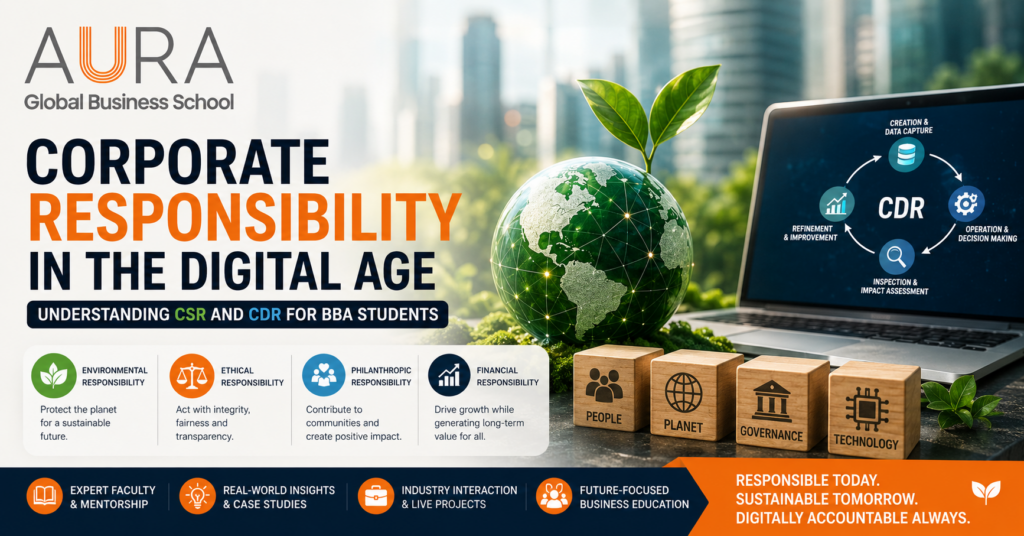
Corporate Responsibility in the Digital Age: Understanding CSR and CDR for BBA Students
Corporate Social Responsibility (CSR)
Definition “CSR, it is a self-regulating model that helps a company be socially accountable to itself, stakeholders, and the public” (Investopedia).
Corporate Social Responsibility (CSR) refers to the ethical and strategic commitment of corporations to contribute positively to society while maintaining economic performance. In modern business theory, CSR is no longer viewed as merely charitable activity; instead, it is considered an integrated management philosophy that balances profitability with social welfare, environmental sustainability, and stakeholder interests. Research was performed on 522 corporate companies in south Asia and the results exhibits with greater availability of cash holdings; firms significantly reduce their reliance on external financing to perform CSR activities. To understand the financial impact of CSR, research was made on 30 companies listed on BSE, and only 6 out of 30 were found technically efficient (which means only 6 companies produce their maximum output from a given set of resources) and are aligned CSR pillars (Deb D., Gillet P., Bernard P., De A (2025)).
Important pillars of CSR
- Environmental responsibility: CSR is rooted in preserving the environment. A company can pursue environmental stewardship by recycling materials, reducing pollution and emissions in manufacturing, replenishing natural resources like trees, or creating product lines consistent with CSR.
- Ethical responsibility: CSR includes acting fairly and ethically. Instances of ethical responsibility include fair treatment of all customers regardless of age, race, culture, or sexual orientation; favourable pay and benefits for employees; partnerships with diverse vendors; full disclosures; and transparency for investors.
- Philanthropic responsibility: CSR requires a company to contribute to society, whether it donates profit to charities, enters into transactions only with suppliers or vendors that align with it philanthropically, supports employee philanthropic endeavours, or sponsors fundraising events.
- Financial responsibility: A company might make plans to be more environmentally, ethically, and philanthropically focused. However, it must back these plans through financial investments in programs, donations, or product research including research and development for products that encourage sustainability, creating a diverse workforce, or implementing diversity, equity, and inclusion (DEI); social awareness; or environmental initiatives.
Irrespective of the sectors (like hotels, food, IT, transport, aerospace etc.), CSR is important in achieving sustainability development goals within a society. And many empirical research shows effective results how the various parameters associated (green finance, financial technology adoption, etc.) mutually strengthens company growth over the consecutive annual years and environmentally associated sustainability performances. CSR shapes sustainable and ethical business practices in the modern corporate world. While CSR offers numerous benefits such as improved reputation, customer loyalty, employee engagement, investor confidence, and long-term profitability, it also presents
challenges including high costs, greenwashing risks, measurement complexities, and stakeholder conflicts. Therefore, successful CSR implementation requires strategic planning, transparency, ethical leadership, and long-term commitment.
Academic scholars (R. Edward Freeman, 1984; Archie B. Carroll, 1991) significantly shaped CSR literature through Stakeholder Theory and Carroll’s CSR Pyramid. These frameworks argue that organizations are responsible not only to shareholders, but also to employees, customers, governments, communities, and the environment.
Corporate Digital Responsibility (CDR)
Definition “CDR, the set of shared values and norms guiding an organizations operation with respect to four main processes related to digital technology and data. These processes are the creation of technology and data capture, operations and decision making, inspection and impact assessment, and refinement of technology and data.
While CDR (Lobschat, L., Mueller, B., Eggers, F., Brandimarte, L., Diefenbach, S., Kroschke, M., & Wirtz, J. (2021)) is an extension of CSR, explains the digital attractiveness within CSR activities. CDR only concentrates with data and technology further it has four key cycles (known as pillars) creation, operation and decision making, inspection and impact assessment, and refinement involving within individual, organizational, artificial/technological, and institutional/governmental/legal actors.
Creation of technology and data capture refers to the initial stage in which new technologies are developed and data are collected. In the operation and decision-making stage, the new technologies get applied and the data are put to work, such as to create customer profiles, to ultimately support decision making whether by human or artificial actors, or a mixture thereof. The inspection and impact assessment stage features assessments of the resulting outcomes and captures how and to what extent an organization relies on those outcomes in future instances of decision making. Finally, the refinement of technology and data stage relates to potential revisions of technologies and data, as well as the possibility of terminating an application or deleting data.
These stages demonstrate that CDR operates as a continuous digital governance cycle where technologies are constantly evaluated, monitored, and improved for ethical compliance and responsible outcomes. CSR, on the other hand, usually focuses on long-term social responsibility programs and sustainability strategies.
Despite their differences, CSR and CDR are deeply interconnected. CDR can be considered a modern digital extension of CSR because digital technologies now influence almost every dimension of business operation, customer interaction, governance, marketing, finance, and organizational strategy. Companies that genuinely pursue sustainable and ethical business practices must therefore integrate both CSR and CDR into their corporate frameworks. A socially responsible company in the modern era is expected not only to protect the environment and society but also to ensure ethical management of technology and data. However, in digital contexts a clear distinction of these main stages is difficult, because they tend to overlap.
Role of a BBA Student in Understanding CSR
For a student pursuing a Bachelor of Business Administration (BBA), CSR is highly relevant because modern management increasingly integrates sustainability, ethics, ESG, and stakeholder management into business strategy. A BBA student can identify CSR involvement by analysing:
- Company Annual Reports
- Official Company Websites
- ESG Ratings and Rankings
- Employee Reviews and Public Perception
- Media and Public Initiatives
The role of a BBA student in understanding CSR extends beyond academic learning into practical engagement with ethical business practices, sustainability initiatives, and stakeholder management. As modern businesses increasingly integrate CSR and ESG principles into their strategies, future managers must develop the ability to balance profitability with social and environmental responsibility. By analysing company disclosures, sustainability reports, ESG rankings, public perception, and corporate initiatives, BBA students can critically evaluate organizational responsibility and ethical conduct. At the same time, active participation in sustainability projects, social entrepreneurship, CSR internships, and community service enables students to become socially responsible leaders capable of contributing positively to both business and society (United Nations Global Compact (2023)).
Why This Matters for BBA Students?
For BBA students, understanding both CSR and CDR are highly important because future management practices increasingly depend on sustainability, ESG integration, ethical leadership, digital governance, and responsible innovation. Modern business graduates are expected to possess knowledge in:
- Ethical business management
- Sustainability and ESG analytics (World economic forum)
- Data ethics
- AI governance (Floridi, L. (2010)).
- Digital risk management
- Stakeholder engagement
- Corporate governance
Students specializing in Marketing, Finance, HRM, Business analytics, and operations management can particularly benefit from understanding the relationship between CSR and CDR. For example:
- Marketing students can study ethical digital advertising and consumer privacy.
- Finance students can analyse ESG and digital governance investments.
- Business analytics students can evaluate data ethics and AI accountability.
- HR students can examine digital workplace ethics and employee surveillance policies.
Which companies are actively involved in CSR activities and maintain CDR in India?
- Deloitte
- Reliance Industries Limited (RIL)
- Tata Group
- HDFC Bank
- ITC Limited
- Infosys
These companies follow well-defined internal strategies to promote sustainable practices, develop professional job skills, and enhance education to meet world-class standards such as the International Baccalaureate (IB) framework. They actively address local community needs while maintaining strong organizational policies that support gender equality, employee wellbeing, and mental health initiatives.
In addition, these organizations integrate Corporate Digital Responsibility (CDR) into their operations to ensure that digital transformation remains ethical, transparent, and socially beneficial through the responsible use of Artificial Intelligence (AI) and data-driven technologies. By prioritizing data privacy, cybersecurity, and ethical digital governance, companies aim to build trust among stakeholders and consumers. Furthermore, they extend support to communities and clients by helping bridge the digital divide, ensuring that the benefits of technological advancement and digital innovation are accessible to all sections of society.
Ultimately, CSR and CDR together represent the future of responsible business management. CSR ensures sustainable and ethical relationships between businesses and society, while CDR ensures ethical and transparent relationships between businesses, technology, and digital stakeholders. In the evolving global economy, organizations that successfully integrate both frameworks are more likely to achieve long-term sustainability, stakeholder trust, innovation leadership, and competitive advantage. CSR is no longer just philanthropy; it is becoming a strategic business model shaping the future of global management.
References
Investopedia. (2024). Corporate social responsibility (CSR) definition. Retrieved May 25, 2026, from https://www.investopedia.com/terms/c/corp-social-responsibility.asp.
Carroll, A. B. (1991). The pyramid of corporate social responsibility: Toward the moral management of organizational stakeholders. Business Horizons, 34(4), 39–48. https://doi.org/10.1016/0007- 6813(91)90005-G.
Freeman, R. E. (1984). Strategic management: A stakeholder approach. Pitman Publishing.
Deb D., Gillet P., Bernard P., De A (2025). Examining the Impact of Corporate Social Responsibility on the Financial Performance of Indian Companies. FIIB Business Review, 14 (4), pp. 521 – 539, https://doi.org/10.1177/23197145221099682.
Floridi, L. (2010). Information ethics. In L. Floridi (Ed.), The Cambridge handbook of information and computer ethics (pp. 77–98). Cambridge University Press.
United Nations Global Compact. (2023). The Ten Principles of the UN Global Compact. https://unglobalcompact.org/what-is-gc/mission/principles.
Lobschat, L., Mueller, B., Eggers, F., Brandimarte, L., Diefenbach, S., Kroschke, M., & Wirtz, J. (2021). Corporate digital responsibility. Journal of Business Research, 122, 875–888. https://doi.org/10.1016/j.jbusres.2019.10.006.
World Economic Forum. (2023). ESG and sustainability initiatives. https://www.weforum.org/topics/esg/.


 Chat Now