
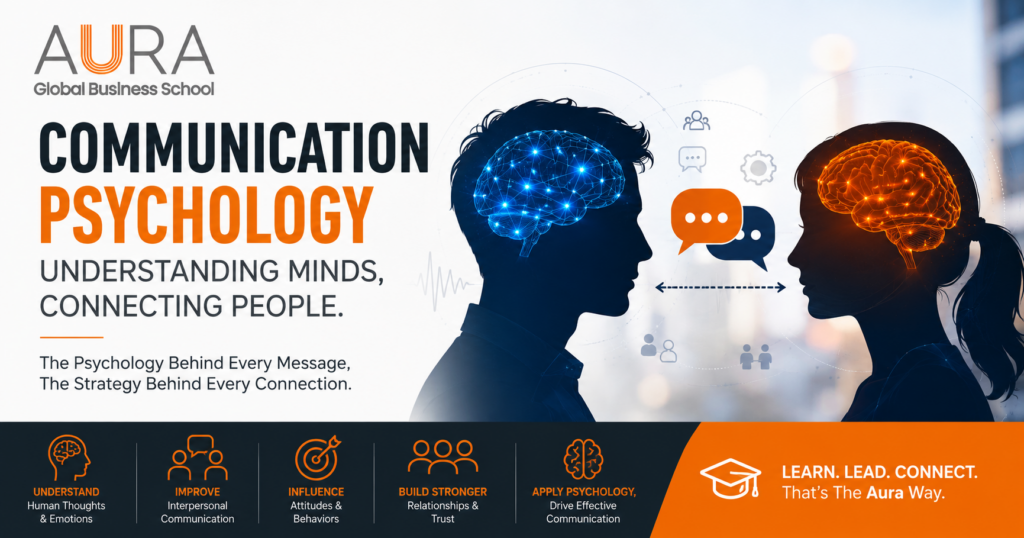
Communication Psychology: History, Concepts, Importance, and Modern Applications
Introduction to Communication Psychology
Communication psychology is the study of how human thoughts, emotions, behaviour, and perception influence the way individuals communicate and interpret messages. It integrates principles from both psychology and communication studies to explain not only how messages are delivered, but also how they are received, processed, interpreted, and remembered by individuals and groups.
Unlike general communication, which primarily focuses on speaking, writing, presentation, and the technical transmission of information, communication psychology explores the underlying mental and emotional processes that shape human interaction. It examines factors such as emotions, attitudes, personality, motivation, perception, cognitive biases, and nonverbal cues that influence communication in daily life.
In essence, communication psychology explains not just what is communicated, but why people communicate the way they do—and why the same message can produce entirely different reactions in different individuals.
History of Communication Psychology
The development of communication psychology reflects a gradual shift from unconscious motivations to observable behaviour, then to cognitive processing, and finally to modern digital and social interaction models.
- Early Foundations (1900s – Psychoanalysis)
The earliest influence on communication psychology came from psychoanalysis, particularly the work of Sigmund Freud. Freud proposed that human communication is deeply influenced by unconscious desires, childhood experiences, and family relationships.
From this perspective, communication is not purely logical or rational. Instead, it often reflects hidden emotions, unresolved conflicts, and subconscious motivations that shape how individuals express themselves.
- Behaviourist Phase (1920s–1940s)
During this period, psychologists shifted their focus to observable behaviour. Behaviourism, represented by thinkers such as B.F. Skinner, explained communication as a stimulus–response process.
In this model:
- A message acts as a stimulus
- The response is the reaction of the receiver
- Internal thoughts and emotions were largely ignored
Communication was therefore understood as a mechanical process rather than a psychological one.
- Post–World War II Shift (1940s–1950s)
After World War II, there was growing interest in propaganda, persuasion, and mass influence. Researchers began studying how messages shape attitudes and behaviour, especially in political and media contexts.
Significant contributions were made by Carl Hovland and colleagues, who demonstrated that communication effectiveness depends on:
- The credibility of the source
- The content of the message
- The characteristics of the audience
This marked a shift toward understanding communication as a persuasive psychological process.
- Cognitive Revolution (1950s–1970s)
The cognitive revolution transformed communication psychology by focusing on how individuals think, interpret, and process information.
A key theory from this era is Cognitive Dissonance Theory by Leon Festinger. It explains that individuals experience psychological discomfort when there is a conflict between beliefs and actions. To reduce this discomfort, people adjust either their beliefs or interpretations.
During this period, researchers also introduced key concepts such as:
- Selective attention
- Selective perception
- Selective memory
These concepts explained why individuals interpret the same message differently based on personal beliefs and experiences.
- Social Learning and Interaction (1960s–1980s)
A major advancement came through Albert Bandura’s Social Learning Theory, which demonstrated that people learn communication behaviours by observing others.
Albert Bandura showed that individuals imitate behaviours seen in parents, peers, media figures, and society. This helped explain the powerful influence of media and role models on communication patterns.
- Modern Communication Psychology (1990s–Present)
Modern communication psychology has expanded into a highly interdisciplinary field. It now includes:
- Digital communication and social media behaviour
- Emotional intelligence
- Interpersonal relationships
- Group dynamics
- Artificial intelligence–based communication systems
Today, communication psychology studies how technology, culture, and human cognition interact to shape communication in everyday life.
Contemporary Psychological Perspectives
Contemporary psychologists, especially after World War II, developed multiple perspectives to explain communication.
Behaviourists viewed communication as stimulus–response interaction, while psychoanalytic thinkers emphasized unconscious emotional influence.
In the 1950s and beyond, research increasingly focused on persuasion and individual differences in influenceability. It was observed that personality traits significantly affect how easily individuals are persuaded.
Researchers also developed important psychological concepts:
- Selective perception: Individuals interpret messages based on personal beliefs and experiences
- Selective attention: Individuals focus only on relevant or emotionally significant information
- Selective retention: Individuals remember information that aligns with existing beliefs
These processes explain why communication is effective in some cases but fails in others.
Cognitive Dissonance Theory
One of the most important theories in communication psychology is Cognitive Dissonance Theory, developed by Leon Festinger.
Leon Festinger explained that people experience mental discomfort when there is inconsistency between beliefs and actions.
For example, if a person believes they are skilled at a task but performs poorly, psychological tension arises. To reduce this discomfort, they may:
- Blame external factors
- Downplay the importance of the situation
- Or take corrective action to improve performance
This demonstrates that individuals often adjust perception rather than accept psychological discomfort.
Additional Areas of Communication Psychology
Modern communication psychology covers a wide range of domains:
Nonverbal Communication
Includes body language, facial expressions, eye contact, and tone of voice. Often, nonverbal cues communicate more than spoken words.
Interpersonal Communication
Focuses on relationships, empathy, listening skills, and emotional understanding.
Mass Communication Psychology
Studies how television, news, films, and social media influence public opinion and behaviour.
Digital Communication Psychology
Examines psychological effects of smartphones, messaging platforms, and social media interactions.
Persuasion and Influence
Explores how advertisements, speeches, and campaigns shape decision-making and attitudes.
Emotional Communication
Studies how emotions spread across conversations, groups, and digital environments.
A key insight by Paul Watzlawick states: “one cannot not communicate,” meaning even silence conveys meaning.
Communication vs Communication Psychology
Communication and communication psychology are closely related but fundamentally different.
Aspect | Communication | Communication Psychology |
|---|---|---|
Focus | Sending messages clearly | Understanding thoughts and emotions |
Goal | Information sharing | Behaviour influence and connection |
Areas | Grammar, speech, presentation | Emotions, perception, cognition |
Example | Writing a report | Understanding audience reaction |
In simple terms:
- Communication = What is said
- Communication psychology = Why and how it is understood
Importance of Communication Psychology in Student Life
Communication psychology plays a vital role in a student’s personal and academic development.
It helps students:
- Reduce fear of public speaking
- Build confidence in communication
- Improve listening and comprehension skills
- Perform better in group projects
- Resolve conflicts effectively
- Develop emotional intelligence
- Understand teachers, peers, and social situations
- Improve academic and professional readiness
It also enhances awareness of body language, tone, and emotional cues, enabling students to communicate more clearly and confidently.
Importance for BBA Students
For Business Administration students, communication psychology is especially valuable because business revolves around human interaction.
Communication as a Foundation
It enables students to:
- Write professional emails
- Prepare reports
- Deliver presentations
- Communicate effectively in corporate environments
Communication Psychology as a Competitive Advantage
It helps students:
- Influence behaviour and decision-making
- Understand customer psychology
- Handle negotiations
- Lead teams effectively
- Motivate individuals and groups
Applications in Business Fields
Marketing:
Understanding consumer emotions, trust, and decision-making patterns
Human Resources:
Managing workplace conflict, motivation, and organizational behaviour
Sales and Negotiation:
Building trust, addressing customer concerns, and closing deals
Leadership:
Managing change, inspiring teams, and improving workplace culture
Communication Psychology in Presentations
A standard presentation shares information, but a psychologically effective presentation:
- Captures attention
- Builds emotional connection
- Motivates action
Key Techniques:
- Keep slides simple to avoid cognitive overload
- Make a strong first impression through confidence and body language
- Use storytelling for better retention
- Handle questions calmly and confidently
Communication Psychology in AI
Communication psychology is increasingly important in Artificial Intelligence systems.
AI tools such as chatbots, virtual assistants, and recommendation systems use psychological principles to understand user behaviour.
Examples include:
- Chatbots offering emotionally supportive responses
- Virtual assistants interpreting tone and intent
- Social media algorithms predicting user preferences
- Educational AI adapting to learning behaviour
Importance in AI:
- Improves emotional understanding in machines
- Enhances user experience
- Reduces communication errors
- Builds trust between humans and technology
For students, AI-based communication tools help:
- Improve learning
- Build confidence
- Provide feedback and support
Conclusion
Communication psychology has evolved from unconscious emotional theories to advanced cognitive, social, and digital frameworks. It now plays a central role in education, business, leadership, counselling, media, and technology.
In today’s world, success is not defined only by knowledge, but by the ability to connect with people effectively. Communication psychology helps individuals become confident speakers, active listeners, emotionally intelligent thinkers, and effective leaders.
Ultimately, it transforms communication from a simple exchange of information into a powerful tool for understanding, influence, trust, and human connection.


 Chat Now